Spring Island has one course, Old Tabby Links, a private 18-hole Arnold Palmer design that opened in 1993 with Palmer's partner Ed Seay as lead architect. With about 400 homes on 3,000 acres, play is low-density, and dogs are welcome on the course.
A 2012 renovation by the Arnold Palmer Design Company rebuilt and regrassed the greens, moved some out of the shade, widened fairways and reduced bunkers. It plays 7,135 yards from the back tees and has been a Certified Audubon Cooperative Sanctuary for more than 20 straight years.
A Golf Performance Center adds indoor and outdoor hitting bays and a club-fitting studio. Visit Old Tabby Links.
Spring Island fees come in two parts as of 2026: POA dues of $7,698 a year and club dues of $24,150 a year. Spring Island is a 3,000-acre island community with just 400 home sites and 1,100 acres held as nature preserve, and that ratio explains a great deal about the cost structure. A small number of owners carry a very large amount of protected land.
Fee | Amount | How often | What it applies to |
|---|---|---|---|
POA annual dues | $7,698 | Per year | All owners |
Club annual dues | $24,150 | Per year | All members |
POA dues, monthly equivalent | $641.50 | Per month | All owners |
Club dues, monthly equivalent | $2,012.50 | Per month | All members |
Initiation fee | $150,000 | Once, at purchase | All buyers |
Trust fee - home sale | 1% of the sale price | Once, at closing | Home resales |
Trust fee - homesite sale | 1.5% of the sale price | Once, at closing | Homesite resales |
POA capital charge | $1,000 | Once, at purchase | All buyers |
Club capital charge | $2,000 | Once, at purchase | All buyers |
All figures as of 2026.
The community does not publish a line-by-line breakdown of which charge funds what, so here is what Spring Island maintains. Establishing how the POA dues and club dues divide responsibility is on the verification list below.
Old Tabby Links. An Arnold Palmer designed course, notable for low-density play and for permitting dogs on the course.
The 1,100-acre nature preserve. Held for conservation, and the defining feature of the community.
The 30-acre Equestrian Center. With a 24-stall barn, 16 paddocks and more than 30 miles of riding trails.
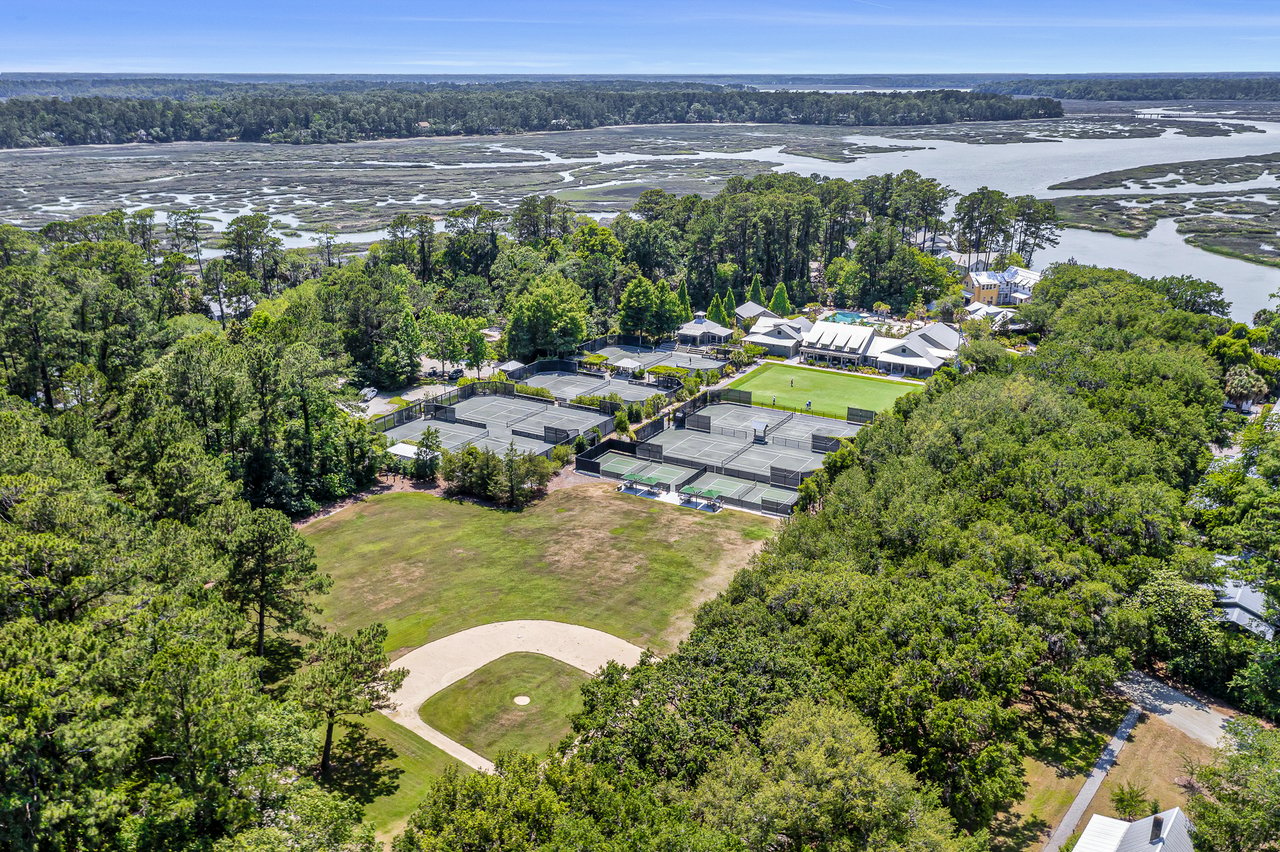
The Sports Complex, Art Barn and Summer House theater.
Waterfall Farm. A native plant nursery and working farm.
Croquet lawns, a clay range and water access. For kayaking and fishing.
Multiple dining venues. Across the island community.
The conservation structure is part of what you are funding. The Spring Island Trust and the LowCountry Institute were formed in 1990 and 1998 and merged in 2017, supporting cultural heritage, environmental education, conservation and research. This is not a marketing line: the Trust fee at closing is a real charge, and the 1,100 acres of preserve is real land held out of development permanently.
Equestrian boarding and riding. The Equestrian Center is substantial and its use carries separate charges.
Spring Island has the most layered set of purchase costs of any community covered here, with four separate charges at closing.
The initiation fee - $150,000. Paid once at purchase, separate from the price of the home.
The Trust fee - 1% on a home sale, 1.5% on a homesite sale. Note that homesites carry the higher rate. On a $2M home that is $20,000; on a $1M homesite it is $15,000. This funds the conservation structure rather than the club.
A POA capital charge - $1,000.
A club capital charge - $2,000.
On a $2M home purchase. The initiation, Trust fee and two capital charges come to roughly $173,000 between them, on top of the price of the home. That is the number to plan around.
Both the POA dues and the club dues are set annually, so there are two figures that can move rather than one. When you ask for the history, ask for both. Spring Island's structure, a small owner base maintaining 3,000 acres including 1,100 acres of preserve, means the per-owner cost of stewardship is inherently high, and that is a permanent feature of owning here rather than a temporary condition.
Before you write an offer, here is what I would want confirmed in writing:
Both dues figures confirmed in writing, and how responsibility divides between the POA and the club
Whether club membership is required with ownership, and whether it transfers to a buyer
Whether any portion of the $150,000 initiation is refundable equity
Confirmation of the Trust fee rate that applies to your specific purchase, since homes and homesites differ
The last three to five years for both dues figures
Whether any special assessment has been levied recently or is under discussion
What are the current HOA fees on Spring Island?
Spring Island fees come in two parts as of 2026: POA dues of $7,698 a year and club dues of $24,150 a year. That is about $641 and $2,012 a month respectively.
What is the Spring Island initiation fee?
The initiation fee is $150,000 as of 2026, paid once at purchase and separate from the price of the home.
What is the Spring Island Trust fee?
A charge at closing of 1% of the sale price on a home, or 1.5% on a homesite. It funds the conservation structure. On a $2M home that is $20,000.
Are there one-time fees when buying on Spring Island?
Yes, four. The $150,000 initiation fee, the Trust fee at 1% on a home or 1.5% on a homesite, a $1,000 POA capital charge and a $2,000 club capital charge. On a $2M home those come to roughly $173,000 in total.
What do Spring Island fees cover?
The community maintains Old Tabby Links, the Arnold Palmer course, the 1,100-acre nature preserve, the 30-acre Equestrian Center with over 30 miles of riding trails, the Sports Complex, Art Barn, Summer House theater, Waterfall Farm, croquet lawns, a clay range, water access and several dining venues, across 3,000 acres.
Why are Spring Island fees high?
Four hundred home sites carry the cost of 3,000 acres, including 1,100 acres held permanently as nature preserve. The low density and the conservation commitment are the point of the community, and the per-owner cost of maintaining that is the direct consequence.
Spring Island asks a lot financially and gives something genuinely rare in return, and the four separate charges at closing need laying out clearly before you decide. Call me and I will put the full picture in front of you.
282 people live in Spring Island, where the median age is 62 and the average individual income is $70,504. Data provided by the U.S. Census Bureau.
Total Population
Median Age
Population Density Population Density This is the number of people per square mile in a neighborhood.
Average individual Income
There's plenty to do around Spring Island, including shopping, dining, nightlife, parks, and more. Data provided by Walk Score and Yelp.
Explore popular things to do in the area, including Golfon International.
Spring Island has 381 households, with an average household size of 2. Data provided by the U.S. Census Bureau. Here’s what the people living in Spring Island do for work — and how long it takes them to get there. Data provided by the U.S. Census Bureau. 282 people call Spring Island home. The population density is 516 and the largest age group is Data provided by the U.S. Census Bureau.
Total Population
Population Density Population Density This is the number of people per square mile in a neighborhood.
Median Age
Men vs Women
Population by Age Group
0-9 Years
10-17 Years
18-24 Years
25-64 Years
65-74 Years
75+ Years
Education Level
Total Households
Average Household Size
Average individual Income
Households with Children
With Children:
Without Children:
Marital Status
Blue vs White Collar Workers
Blue Collar:
White Collar: