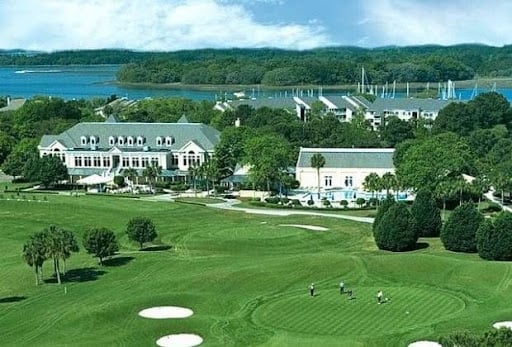
When Arthur Hills was tasked with creating a course for Palmetto Dunes’ new offshoot Leamington neighborhood, he knew he was building on a legacy of great golf in the community. The Robert Trent Jones course took full advantage of Palmetto Dunes’ oceanside aesthetic. The George Fazio course provided a true test of skill wrapped in a lushly natural setting. With his course, Hills looked to do something different.
He wanted to create a course that rewarded precision and strategy just as much as skill. He wanted to create a course for the golfer who thought two shots ahead. Forty years later, with accolades like being named one of the “Top 30 Best Courses You Can Play in South Carolina,” it’s fair to say he succeeded.
Viewed through the lens of the modern golfer taking the course on decades after it was built, Arthur Hills’ 6,651 yards may not intimidate. But that has always been the point. This course lulls you into a false sense of security with seemingly simple holes that challenge with off-balance lies, ever-changing ocean breezes, razor-thin landing areas and lagoons that weave through 10 different holes. You can’t overpower this course. Instead, you need to understand it.
Because then you’ll be able to know why the course is demanding every club in the bag, with a great balance of incredible drives and strategic approaches. A different club, a more conservative line, a precise reading of the wind and an ability to take your medicine are all vital.
Learn more about the course and reserve your tee time at their official website, Arthur Hills Golf Course at Palmetto Dunes.
The Island's Most Cerebral Challenge
Smart golfers understand that a good score isn’t always a matter of hitting the perfect shot but putting yourself in a better position to take the next one. Across multiple par-fives, Arthur Hills has rewarded that intelligence with plenty of chances to earn back lost ground. It also provides plenty of ways to yank birdies away from those who pursue it too aggressively, with plenty of water, plentiful out-of-bounds areas and approach angles that can twist like a pretzel.
What’s especially impressive in the way Hills set up these subtle traps is the way he used the natural terrain to create them. Rather than dig a bunker in every fairway, he let tree lines narrow greens, found ways to utilize the rare elevation and angle changes from ridges that typically aren’t found on Hilton Head Island, and put those lagoons to good use. It’s almost like the island was waiting for someone to use this terrain to craft a course that would reward smart play.
But perhaps the biggest natural hazard the island lent to Arthur Hills was its interminable breezes. Swirling off the ocean, the wind can turn an otherwise manageable hole into a test of willpower and club power. Constantly changing and requiring a careful eye, it adds to a host of natural challenges that serve as their own architects.
A Lowcountry Course That Lets Nature Set the Terms
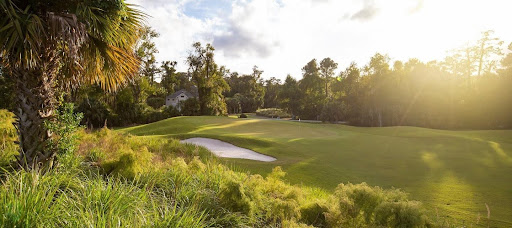
The Arthur Hills course didn’t just use the natural challenges presented by the Lowcountry’s terrain to challenge. It also used them as one of the most mesmerizing backdrops in golf. Native plants, lagoons, and thick strands of palmettoes are exquisite window dressing to each fairway, with water coming into play strategically.
The course moves through this natural beauty with an inspired rhythm. On some holes, open fairways invite you to pull out your driver, while others will subtly hint at a different strategy off the tee. Parsing those hints is half the challenge. But despite demanding your full attention, the course still indulges with elevated tees, wooded corridors and Lowcountry contours that create a sense of movement.
This is not a course that attempts to overwhelm you with length and spectacle. Instead, it whispers with each hole quiet reminders to gauge where you want to land, determine how much club you’ll need, factor in the wind and always have a plan B. Approach the course with a strategic mind, and you’ll be rewarded.
Hole-by-Hole
Hole 1: Par 4, 384 yards from the blue tees
Your first test of instinct comes just after your first shot, which you’ll want to keep right center of the fairway. Your club selection will determine whether you can beat the wind to the shallow green.
Hole 2: Par 4, 373 yards from the blue tees
Yes, this par four is short, but placement is far more vital than distance here. Precision breeds success, and an approach shot that skirts the OB and water around the green is a must.
Hole 3: Par 3, 146 yards from the blue tees
The wind can be tricky here, particularly over the water hazard you need to clear. Keep it to the center of the green if the breeze lets you.
Hole 4: Par 4, 430 yards from the blue tees
At last, this course lets you test out the big driver. Out-of-bounds lies along the left, so keep it right, but prepare to adjust for your approach to the deep green.
Hole 5: Par 4, 376 yards from the blue tees
Now that you’ve shown off, it’s time to put the driver away and pull back to 150 yards. It will help you navigate the narrow fairway to the elevated putting surface.
Hole 6: Par 5, 505 yards from the blue tees
The tall grass on the left is flush with the balls of errant tee shots. Stay right-center off the tee, and keep it right on the approach to counter the green’s slope.
Hole 7: Par 4, 434 yards from the blue tees
An open fairway practically begs you to drill one off the tee. But beware that second shot – it’s downhill, but the wind doesn’t play fair.
Hole 8: Par 3, 156 yards from the blue tees
Looks can be deceiving on this hole, with the wind seeming to lengthen the distance. Watch how far right the pin is placed – you’ll need more club the further it is.
Hole 9: Par 5, 518 yards from the blue tees
The temptation to let loose with your driver might be too much to bear, but a layup to the 150-yard marker takes the water out of play and shortens the downhill approach.
Hole 10: Par 4, 415 yards from the blue tees
Embrace the curve of the dogleg left, keeping to the right to center your approach shot. With all of the trouble around the green, you’ll be glad you did.
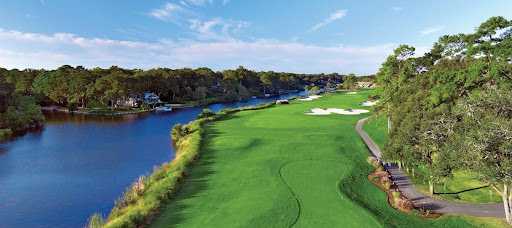
Hole 11: Par 3, 182 yards from the blue tees
Mother nature does a little showing off here, so enjoy the scenery on a downhill par 3 to a deep green ringed by bunkers.
Hole 12: Par 4, 399 yards from the blue tees
This one was a favorite of Arthur Hills, who said, “The fun starts here.” With water on the right, shoot for the left of the 150-yard post and bring a healthy amount of club for the approach.
Hole 13: Par 5, 507 yards from the blue tees
You’ll have to plan carefully to avoid getting wet, with a forced carry over water and more water in front of the green. Keep left off the tee, then approach to a narrow second shot and brutal approach.
Hole 14: Par 4, 412 yards from the blue tees
If you want to see green off the tee, stay right. If you want to approach it with any success, pay close attention to where the pin is placed on its two tiers.
Hole 15: Par 3, 153 yards from the blue tees
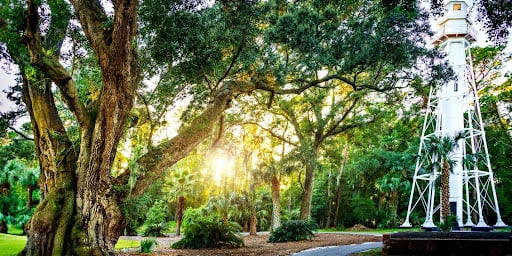
Sure, that other lighthouse gets all the golf accolades, but Hilton Head’s only historic lighthouse towers over this hole, distracting you from a tricky divided green.
Hole 16: Par 4, 365 yards from the blue tees
As short as this par four is, it provides plenty of pitfalls on the way to a deep green where pin placements can move as much as 20 yards. Stay left off the tee, then keep your wits about you.
Hole 17: Par 4, 380 yards from the blue tees
The landing area may not look like much, but it allows for a healthy drive off the tee. It’s the approach that will get you, with OB, water and woods surrounding the green.
Hole 18: Par 5, 516 yards from the blue tees
Navigate the zig-zag of the fairway and the sizable mounds before the green and you might just make up for missed shots on this final hole.
The distinct challenge offered by the Arthur Hills course at Palmetto Dunes is one that rewards sharp thinking. The natural landscape, ever-changing winds and subtlety of its hazards are as much a cerebral challenge as they are a physical one. A solid drive will only take you so far, but this is not a course you conquer on distance alone.
That only adds to the appeal. It’s a course you feel less like you’ve conquered so much as you’ve understood it, reading its subtle clues correctly. In a place like Hilton Head Island, where famed courses challenge every aspect of your game, this is one that the smart golfer approaches like a wonderful puzzle worth solving.
Thinking About Palmetto Dunes?
As a Hilton Head native and luxury real estate advisor, I can walk you through what's available, what's coming, and whether Palmetto Dunes is the right fit for your goals. Reach out here — no pressure, just honest answers.
Call John Campbell at (843) 816-0627; contact me here.